Resisting a Nation without Citizens
Introduction
Formed in 1989, Sahmat’s first open call, Artists Alert, encouraged Indian artists to claim their democratic freedoms within civil society. Following its nationwide campaign Artists Against Communalism (1991), Sahmat protested the demolition (on 6 December 1992) of the Babri Masjid with daring projects that defied bans, and took exhibitions, music performances, film and street theatre to mammoth gatherings on embattled ground across the country, including Ayodhya.
During 1999–2004, Sahmat hosted symposia on economic and education policies, organised a campaign against communalisation of education and expanded its publication and poster campaigns. Crucially, it stepped up public enquiry platforms after the 2002 communal carnage in Gujarat. Over the last 35 years, Sahmat has worked to secure the rights of minorities within a secular nation-space, and organized solidarity campaigns for M.F. Husain and Habib Tanvir among others. It paid tributes to eminent writers Premchand, Faiz, Manto, Nagarjun and Bhisham Sahni. SAHMAT also organised Lecture Series on Mahatma Gandhi, Jawaharlal Nehru, Seventy Years of Indian Freedom.
By challenging the government actions, the judiciary and the media over issues of constitutional rights and social dignity, Sahmat has given the artistic community a form of address and a place in public culture from where to critique and reshape the national imaginary.
The present exhibition, Hum Sab Sahmat, follows in the trail of several others: Hum Sub Ayodhya (1993), Postcards for Gandhi (1995), Ways of Resisting (2002), Sahmat 20 Years: Image Music Text (2009), Forms of Activism (2014), Aavaz Do (2016), We the People (2020), Constitution at 70 (2020) India is not Lost (2021), to name a few.
The exhibition Hum Sab Sahmat
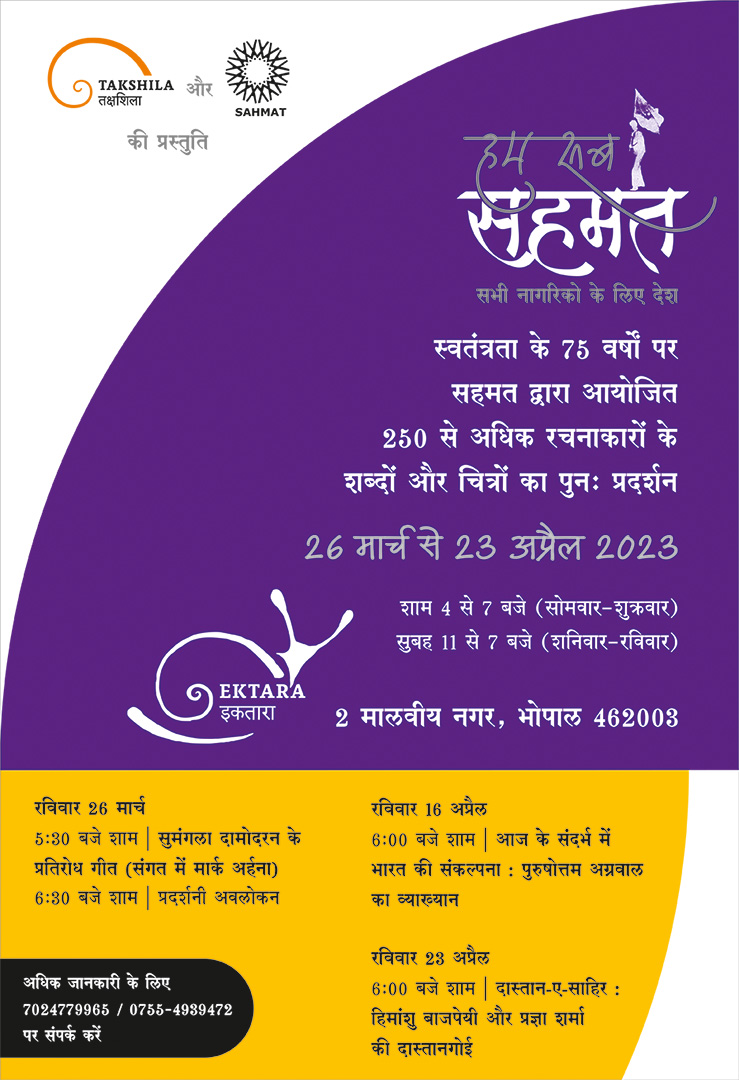
The exhibition, “Hum Sab Sahmat: Resisting a Nation without Citizens”, displaying artistic expressions of over 250 artists, photographers and writers, is not only an ode to the core values that have guided Sahmat’s democratic mission, but also an event to collectively reflect upon the present conjuncture. It has been seventy-five years since we made a solemn commitment to equal rights and dignity to all its citizens as enshrined in the Constitution. However, in recent days, it is both the spirit and the text of this sovereign document that finds itself increasingly under attack.
While shrinking democratic spaces prefigure our Exhibition, we are equally concerned at the decontextualization of art and politics. The latter is a result of not merely statist practices of shifting patronage and priorities, but also through monetization and commercialization of artistic production. In response, we at Sahmat continue to extend the possibilities of art by producing new pathways of circulation. The material used to display these works and the corollary arrangement of works are easy to transport through different terrains, meant to withstand the vagaries of local climate and allow a variety of viewers to appreciate and organically imbue meaning to what they are seeing. The contributors to the exhibition too, represent an incredible cross-section of generations, sensibilities and political motivations without necessarily privileging any one over the other. The exhibition also reflects linguistic, cultural and creative diversity of India.
With the support of Takshila Educational Society, the exhibition a part of the year-long SAHMAT project was incepted last year marking the 75th anniversary of India’s independence at Jawahar Bhavan, New Delhi. This year celebrating and resisting with the same spirit, it has traveled to Ektara, Bhopal.
.jpg)
.jpg)
.jpg)
.jpg)
.jpg)
.jpg)
.jpg)
.jpg)
.jpg)
.jpg)