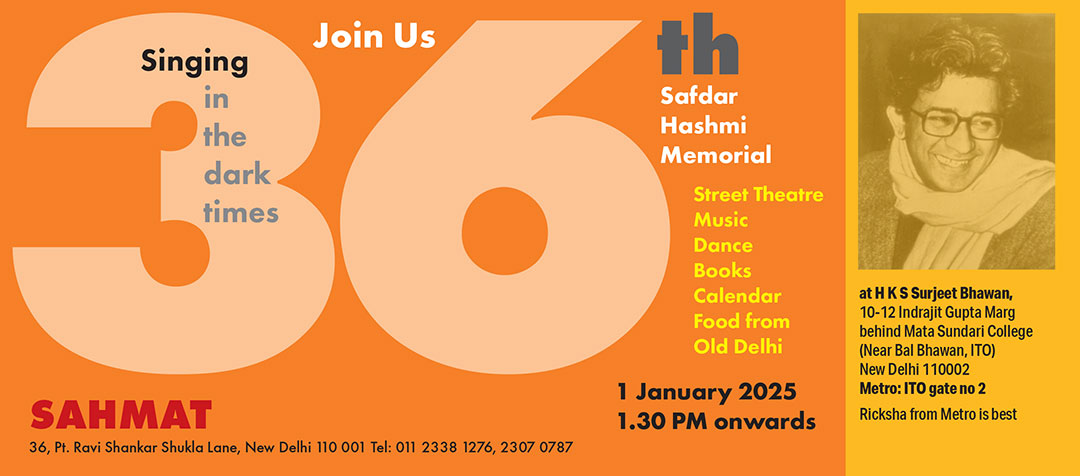
On 1 January 2025, Harkishen Singh Surjeet Bhavan was the venue for the 36th Safdar Hashmi Memorial Trust’s annual celebrations. Organized every year to mark the life, the works and the ideals of Safdar Hashmi who was attacked on this day while performing a street play with his troupe, Jan Natya Manch, SAHMAT has become a cultural artefact in its own right. This year was a somber occasion as SAHMAT lost one of its most beloved and avid supporter in Com. Sitaram Yechury, General Secretary of the Communist Party of India (Marxist). While traditionally, the SAHMAT program is accompanied by an art exhibition, this year’s event was more muted. On display were photographs of Yechury and Shyam Benegal at Sahmat, few of which were taken by Ram Rahman, Parthiv Shah, besides those taken by Bunty at SAHMAT.
Another cultural giant that the world lost in 2024, and a man who too stuck close to the values of secular, just cosmopolitanism that SAHMAT has come to represent was tabla maestro, Zakir Hussain. The cultural program aptly began with a tribute to the maestro himself with an old video recording from the Trust’s archives where Hussain performed for SAHMAT on the occasion of 125th Birth Anniversary of “Mahatma” M.K. Gandhi. An old footage of Gandhi on his Salt Satyagraha March played with Hussian, accompanied by three other doyens of Indian percussion (Vikku Vinayakram, Selvan Ganesh and Bhawani Prasad on ghatam, pakhvaj and kanjira), performed to the footage. Ram Rahman paid tributes to Shyam Benegal and artist Nand Katyal and the calendar for 2025, designed by artist-designer Vijender Vij was released that documents Yechury’s long association with SAHMAT.
The afternoon’s cultural performances was headlined by Priyakshi- a contemporary dancer originally from Jaipur, Rajasthan- who spun a moving performance inspired by a letter composed by activistlawyer Sudha Bhardwaj’s daughter after her mother’s incarceration. From that point onwards, the program followed its usual itinerary of poetry and songs, in the auditorium and friends and associates of SAHMAT milling around outside at the book stalls and food counters. Another young performer whose voice is becoming more regular on 1 January’s program, Aanya regaled the audiences with songs of hope and beauty before breaking into an impromptu rendition of Faiz Ahmed Faiz’s “Hum Dekhenge”. She was followed by Deepak and Ruchika Castelino’s song performance. In another shift from conventions, the 1 January events are closed by Madan Singh Gopal and his “Chaar Yaar”, but this year Gopal went up in the afternoon still to the usual delight of those in the audience. A new set of performers this year was a group of young men from Panjab, 1 Ferro Fluid who sang to a near packed auditorium. Shifting between narrative and songs, drawn from Panjab’s rich tradition of Sufi-Bhakti-heterodox philosophers like Bulle Shah, Baba Farid and Kabir, the four men held the audience in rapt attention. Rekha Raj and Meeta Pandit ended the evening’s lineup with their stirring performances. The emcee of the evening, Sohail Hashmi brought the lineup of performances to an end with his vote of thanks.
To anyone looking from the outside, or for the uninitiated, SAHMAT may always seem like an inscrutable object. It is not a structured organization, or trust, in a conventional sense. It derives its relevance from the voluntary labour and dedication of those informal “sahmatis” that have made the organization relevant through its over three-decades journey. Perhaps the best way to understand and describe SAHMAT is to attend its 1st January event. It is here that the multitudes in which it stands become legible. On this day, there is the solemn attendance of those seated in the “performance hall – decorated a day earlier from wooden boards, drapes and everyday objects- and there is the joyous humdrum of people outside, discussing sundry from the going-ons around the world to the more sordid tales of traffic jams in Delhi on that day. It is a space for people to meet, reconnect and make new acquaintances – all of which was at full display even this year.
This is not to say that SAHMAT stands outside the limits of our shared vocabulary but rather to appreciate the meanings that it enables to those words. Of course, it is a collective of artists and performers & it is also a site of political action, a place of intellectual validation, an intersection of texts and images. In recent years, SAHMAT has done its work despite daunting challenges – not all of which can be summed by an establishment hellbent on shredding the radical, secular values on which the Trust was first conceived.
Sitaram Yechury was one such figure who made SAHMAT legible for the outside world. His relationship with SAHMAT was built on intimate friendships, and a belief in the transformative agency premised on breaking down elite/ popular culture. He broke bread at SAHMAT, shared jokes and qissas on leisurely afternoons, sought advice, forwarded opinions when drawn in. His frequent visits were, in no small measure, responsible to guide the political content of SAHMAT, without ever reducing it for electoral gains. This author recalls, quite recently, when Com. Yechury seamlessly used the energy at SAHMAT for its then upcoming exhibition in solidarity with Palestinian people to draw up a special issue of The Marxist, the Party’s intellectual journal, on the 2 history of Palestinian colonization. There was an entangled symbiosis at display then, and always, between SAHMAT and Com. Yechury’s political trajectory. SAHMAT will hardly become less political with the loss of Com. Yechury but in fact his legacy will continue to inform SAHMAT’s future. In which India that would be, and what particular form of precarity SAHMAT itself will go through, still needs to be seen.
But until then, there will always be singing and laughing at SAHMAT in his honour.
.JPG)
.JPG)
.JPG)
.JPG)
.JPG)
.JPG)
.JPG)
.JPG)
.JPG)
.JPG)
.JPG)
.JPG)
.JPG)
.JPG)
.JPG)
.JPG)
.JPG)
.jpg)
.JPG)
.JPG)
.JPG)
.JPG)
.JPG)